
NTHU Research Team Developing the Next Generation Cryogenic Mirrors
One of the key components of the apparatus recently used by the Interferometer Gravitational-Wave Observatory (LIGO) to verify the existence of gravitational waves was a high-sensitivity laser mirror, and NTHU’s team led by Prof. Chao Shiuh, Institute of Photonics Technology, played a vital role in the team efforts of the LIGO Scientific Collaboration (LSC). The detection instrument, known as “Advanced LIGO,” was operated at room temperature. Prof. Chao’s team is now working on developing the next generation mirror coatings for the detection instruments, which will operate in temperatures of about minus 250 degrees Celsius. This will further reduce thermal noise, thereby making it possible to capture the "sound of the universe" more sensitively and accurately.
Students participating in the study indicated that they were pleased to have had the rare opportunity to work with thousands of scientists from 15 different countries, and to have played a role in the discovery of the "Holy Grail" of physics.
Since optical technology aircraft and missile navigation systems require a very high level of technological precision, according to Prof. Chao, lots of research has been conducted on laser mirrors in relation to laser gyroscopes. In 2010 researchers at LIGO Scientific Collaboration read about his previous publications on coatings for the ring laser gyroscope and invited him to join the team.
Prof. Chao says that even though his research team is “just a small screw in the LIGO team,” he was naturally excited and happy to be a part of such a historic discovery.
Mr. Pan Huang-wei, a Ph.D. student at NTHU’s Institute of Photonics Technology, has been a member of Prof. Chao’s research team for six years. A graduate of the Department Physics, he joined Prof. Chao’s research team to gain some practical experience. He says that for a long time gravitational waves were merely theoretical, something that would take a very long time to actually observe. Thus his family had difficulty understanding how joining such a research team could be of any practical benefit to his career. Last year, when he heard the news that LIGO had actually succeeded in detecting gravitational waves, he was beside himself with excitement; both he and his family are finally convinced that his six years of hard work was not in vain.
Last year Mr. Pan went to the US to attend a LIGO seminar, where he gained a lot of insight into how the directors of the program integrate the various areas of research and guide the huge multinational research team in the right direction. He says, "to understand what all those experts in various fields are doing is quite challenging. Just think of the difficulty of actually coordinating the work of thousands of physicists, astronomers, materials and mechanical engineers, and computer experts!”
Mr. Guo Ling-chi, also a Ph.D. student at NTHU’s Institute of Photonics Technology, joined Prof. Chao’s research team three years ago. He says that he was especially impressed by the intensive and fruitful exchanges they had with the research teams in Italy and Australia. Guo also indicates that through his participation in this international research team he has learned a lot about how to apply a rigorous research to solving problems.
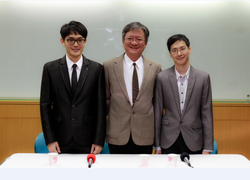
Pan Huang-wei, Prof. Chao Shiuh, and Guo Ling-chi of the Institute of Photonics Technology (left to right).
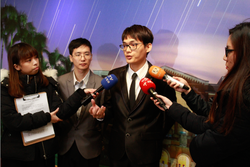
Pan Huang-wei and Guo Ling-chi of the Institute of Photonics Technology at the press conference.
visited: