
NTHU Leads Taiwan in US Patents
The National Academy of Inventors (NAI) and the Intellectual Property Owners Association (IPO), both based in the US, recently announced their “Top 100 Worldwide Universities Granted U.S. Utility Patents in 2015.” This year NTHU was ranked 15th in the world, the highest position amongst all universities in Taiwan, an honor NTHU has held every year since 2012.
In 2015 NTHU received 101 US patents; by adding to this figure the patents granted in Taiwan, mainland China, Japan, and the EU, the total number of patents received by NTHU in 2015 comes to 307. Amongst these, the largest number of patents were received in the area of photonics and optics (66), followed by pharmaceuticals and biochemistry (57), materials and chemical engineering (56), and electronic machinery (53).* It should be noted these patents are from a wide range of applications, not limited to the field of information and communication, as the high-tech industry are developed in Taiwan.
A large number of technologies for which NTHU has received patents have been successfully commercialized for industrial use. Last year, the university completed 137 technology transfer cases worth NT$114.43 million, a record high. NTHU’s income from technology transfers for the first six months of this year come to NT$108.9 million, 95% of last year’s total; and we estimated that this year’s total will be 138% of last year’s, another new record.
According to President Hong Hocheng, NTHU’s high ranking in patents amongst more than 50,000 universities worldwide is a strong testament to the creativity of its faculty members and students and their valuable contributions to the future of industry and to society as a whole. This indicates a strong match between what students learn at NTHU and the actual needs of industry.
According to Professor Pan Ci-ling, Vice President of Office of Research and Development and Director of NTHU’s Operations Center for Industry Collaboration, technological development is rooted in innovation and the accumulation of knowledge. Thus NTHU’s impressive record in patents and technology transfers shows that the ideas and innovations pioneered by its faculty members and students have a very high potential for practical applications and is beneficial to society; it also demonstrates the importance of national investment in higher education and basic research. Pan also emphasizes that knowledge is the driving force behind innovative research and development. For example, even though Thomas Edison was a great inventor, there was no way he could have invented the transistor, since he had no knowledge of quantum mechanics.
NTHU’s excellent reputation for innovative research and development has led many manufacturers to propose cooperative projects with the school. For example, a procedure developed by NTHU researchers for using boron neutron capture therapy (BNCT) to treat liver cancer tumors (patented in Taiwan and the US) has already been transferred to the Taiwan Biotech company, which is currently conducting clinical trials.
Taiwan Biotech’s Senior Vice President Hsien-jen Hsieh recently stated that when his company learned that NTHU and the Taipei Veterans General Hospital were developing a BNCT cancer treatment, they began providing free medicines for use in their experiment. He expects that as a result of such innovations, the use of BNCT in cancer treatment in Taiwan will soon be on par with that of Japan.
Hsieh also pointed out that Taiwan's biomedical industry needs more talented personnel, and he encourages students to investigate the increasing opportunities the field has to offer. In the case of the pharmaceutical industry, many students think that pretty much the only employment options for graduates of a pharmacy program are filling prescriptions at a pharmacy or working for a pharmaceutical company. However, the industry also needs more researcher personnel to further the development of the industry.
For 2015 the top five academic institutions with the most US patents were the University of California, MIT, Stanford, the University of Texas, and Tsinghua University in Beijing. The first four are in the US, and all of them have a much larger faculty than NTHU. In addition to NTHU, the other Taiwanese academic institutions ranked in the Top 100 were NTU (26), NCKU (29), NTUST (80), and NCU (85).
The complete list can be seen at: http://www.academyofinventors.org/pdf/top-100-universities-2015.pdf
*Note: These are NTHU’s classifications of the areas in which patents are given. In the case of a patent that belongs to more than one area, it is classified in the one to which it is most closely related.
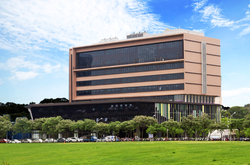
The newly completed building of NTHU’s Innovation Incubation Center.
visited: