
NTHU Research Demonstrates the Math Abilities of Cuttlefish
The jury may still be out on whether or not Paul the Octopus was able to accurately predict the outcome of football games, but it has already been scientifically proven that cuttlefish can perform math. Professor Chuan-chin Chiao of NTHU’s Department of Life Sciences and his research assistant Tsang-yi Yang have demonstrated that cuttlefish know that two is greater than one and that five is greater than four. They also found that cuttlefish require more time to calculate larger numbers.
Their research has recently been published in the prestigious British journal Proceedings of the Royal Society B, and has also been reported as research highlights in this month’s edition of Nature. Professor Chiao pointed out that their findings on the mathematical and risk-assessment abilities of cuttlefish reveal that cognitive functions of many animals are far more advanced than we imagined. He also said that studying the factors affecting what cuttlefish choose to eat not only increases our understanding of the cuttlefish’s ecosystem, but also sheds light on the human decision-making strategies and consumer behavior.
Cuttlefish are cephalopods; amongst all invertebrates, they have the most developed nervous system. In addition to their remarkable camouflage behavior, cuttlefish are considered to be fairly intelligent animals. And although a number of past experiments have confirmed that cuttlefish have higher cognitive functions, no research has attempted to determine whether they have mathematical abilities. Chiao’s research studied the cuttlefish's natural feeding behavior when presented with differing quantities of shrimp, and found that they have a definite preference for larger quantities, e.g., five shrimp as opposed to four shrimp.
How cuttlefish do math?
Chiao said that in order to verify that cuttlefish have a real sense of numbers, rather than simply a preference for whichever group of shrimp has a higher density, in the experiment he presented the cuttlefish with two groups of shrimp with the same density but different quantities, in which case they regularly chose the group with the larger number of shrimp.
In general, humans have two ways of counting. One is “sensory counting,” in which small quantities (usually less than five) are automatically recognized on first sight, without having to actually count them; the other way is to actually count out each item. In order to determine which of these counting methods is used by cuttlefish, the experiment also measured how much time the cuttlefish spent making their choice. It was found that the cuttlefish spent more time when faced with a relatively more complex choice (4 to 5 shrimp) than they did when faced with a relatively simple choice (1 to 2 shrimp), indicating that they were actually counting out the number of shrimp.
Can cuttlefish perform risk assessment?
In the experiment it was also found that when cuttlefish are faced with a choice between one large shrimp and two small ones, if they are hungry they prefer the one large shrimp, but when they are not very hungry they prefer the two small shrimp.
Chiao concludes that this is a kind of risk-assessment strategy, since choosing the larger shrimp is riskier than choosing two small ones; i.e., they are more likely to choose the high-risk, high-reward option, which is the same with humans.
Chiao has also done a lot of research on how cuttlefish use visual information when engaging in camouflage behavior, as well as the related neural control mechanisms. He says that he was pleasantly surprised by all the attention his research on the mathematical ability of cuttlefish has received from foreign media, including Nature and Discover.
The benefits of cuttlefish research
Yang, who is currently a research assistant at the Institute of Systems Neuroscience, laughs when she recalls how she decided to come to NTHU after learning about Chiao’s research on cuttlefish, adding that, “Although the experiments can sometimes be rather tedious or disappointing, I found that simply watching the cuttlefish swimming back and forth was actually very therapeutic; it’s actually a good way of dealing with frustration.” The study used a type of cuttlefish known as the “pharaoh cuttlefish,” which, along with the shrimp, were raised by Yang in pure sea water. After discovering that each cuttlefish had a unique personality, she gave each one a matching name, such as “Sleepy” and “Timid.” However, when one died she became rather dejected, so Chiao had her drop the names in favor of serial numbers. When cuttlefish get angry they spit out a kind of ink. When that happened the whole tank of water would darken, and pretty much all of lab assistants have a few souvenir T-shirts marked with indelible ink spots. Yang was also sporting a smile when she said that the next step was to figure out if cuttlefish have a concept of "zero."
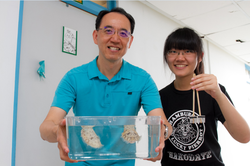
Professor Chuan-chin Chiao and his research assistant Tsang-yi Yang.

Professor Chiao holding a press conference.
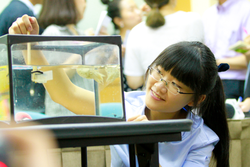
Tsang-yi Yang giving her cuttlefish a math quiz.
visited: