
A New Era in High-entropy Materials Launched at NTHU
The first "International Conference on High-entropy Materials (ICHEM 2016)" was held at NTHU on November 6–9. In his address, Professor Jien-Wei Yeh of NTHU’s Department of Materials Science and Engineering described his development of high-entropy alloys—now regarded as a major breakthrough in the field of metallurgy—as “seeing the light at the end of the tunnel.” Widely hailed as “the father of high-entropy alloys,” Yeh announced that with the joint efforts of the participating researchers, the field of high-entropy materials is about to enter a new era of research and development.
Over the past few thousand years, man-made alloys mainly consisted of a major metal element such as iron or aluminum and a small amount of some other elements, resulting in improved strength and toughness. It was always believed that if other metal elements were to be added in a large amount, the resulting alloy would tend to be brittle. This myth was overturned by Yeh. He first conceived of high-entropy alloys in 1995, and in 2004 he published his research demonstrating the superior qualities of high-entropy alloys consisting of a mixture of five or more different metal elements. His discovery opens new chapter in the history of metallurgy.
In his opening address, NTHU President Hong Hocheng pointed out that it was highly significant to hold the first "International Conference on High-entropy Materials" at NTHU, which was the birthplace of high-entropy alloys some 21 years ago. He also noted that NTHU was honored to host such a gathering of top scientists from around the world.
Also in attendance was Professor Lih J. Chen, the former President of the university, who commended Professor Yeh for his creative and innovative approach to overcoming all sorts of difficulties while exploring uncharted territory. He also pointed out some of the challenges currently being met in the research and development of high-entropy materials, including selecting the optimal combinations from amongst a vast number of possibilities, and the need to develop more effective ways to determine the optimal combinations. In addition, former President Chen pointed out that in regards to demonstrating the commercial applications and economic value of high-entropy alloys, there is still a long way to go.
Alex Peng, President of Materials Research Society Taiwan and General Director of the Material and Chemical Research Laboratories at the Industrial Technology Research Institute (ITRI), introduced the “three treasures” of Hsinchu—rice noodles, glass, and the Hsinchu Science Park—pointing out to the foreign scholars that Hsinchu is famous for its combination of top universities, research institutes, and cutting-edge industries.
University of Tennessee Professor Peter K. Liaw said that high-entropy materials is presently one of the most popular areas of research, and that last year alone more than 250 related papers were published, and have already been cited more than 5,000 times, and that this year those figures are likely to be exceeded. He also said that he expects that in the next 10 to 15 years the field of high-entropy materials will produce a Nobel Prize winner.
A special report titled “Mixed-up metals make for stronger, tougher, stretchier alloys” published in the May 19 issue of Nature recognizes Professor Yeh as the first person to create the field of high-entropy alloys. The article also mentions that at about the same time, Professor Brian Cantor, the Vice–Chancellor at the University of Bradford in the UK, was conducting similar research. Professor Cantor came to Taiwan to attend the conference, during which he said that at that time lots of people regarded the idea of combining a large amount of metals as quite ludicrous, and that it was difficult to find sponsorship for related research. Thus he was very impressed when Professor Yeh’s research began to attract academic attention.
Professor Cantor also stated that Professor Yeh’s work on high-entropy alloys is a fine example of coming up with a good idea and then following up on it.
The conference was attended by about 200 scholars from around the world, 170 of whom presented their recent research in the areas of high-entropy alloys, ceramics, and composites.
Summing up some of the highlights of the conference, Professor Yeh said that while the superalloy turbocharger blades currently used in cars can withstand temperatures of up to 800 degrees Celsius, it’s now expected to be possible to make them out of a high-entropy alloy so that they can withstand higher pressure and temperatures of up to 1,000 degrees Celsius, thereby increasing engine efficiency. He then expressed his appreciation for an oil company representative who traveled a great distance to present a 20-minute report on his company’s development of bearings used in oil well pumps. Professor Yeh also mentioned a report on a theoretical model of high-entropy alloys and a report on a corrosion-resistant alloy which also resists irradiation superior to 304 stainless steel.
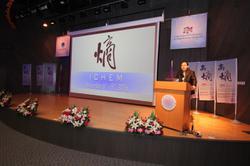
Professor J.W. Yeh speaking at the ICHEM 2016.
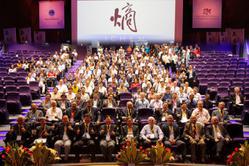
The ICHEM 2016 included participants from around the world.
visited: