
Hitting the Mark in the Treatment of Liver Cancer
It is now possible to eliminate liver tumors without chemotherapy or surgery! A research team that is led by Professor Fong-in Chou at NTHU has developed a new treatment for liver cancer using boron neutron capture therapy (BNCT). Following good results in animal experiments, human clinical trials are expected to begin next year.
According to Professor Chou, BNCT is a type of targeted internal radiotherapy. The first step is to inject the patient with a boron drug, boric acid (BA), which selectively accumulates in the tumor. Then, NTHU’s nuclear reactor is used to perform neutron irradiation for around 30 minutes. The high-energy particles that are produced by the boron neutron capture reaction can effectively kill the tumor cells. The tumors in liver can be successfully eliminated in two fractions of BNCT without affecting the normal liver cell function or obvious side effects. Restated, boric acid can be used to draw a target on the liver tumor cells that can be tracked using a neutron beam, and then kills the targeted cells, wherever they are.
The results of this research have been published in international journals, and patented in Taiwan and the United States. The relevant technology has been transferred to the Taiwan Biotech company.
Chou’s radiobiological research began many years ago. In 2010, NTHU signed a trilateral cooperation agreement with Kyoto University and the Taipei Veterans General Hospital to conduct BNCT research on cancer patients. In 2014, the research team administered a two-fraction BNCT treatment to 17 patients with locally recurrent head and neck cancer, and succeeded in improving the patient's condition and quality of life. Most surprisingly, six participants were completely cured.
The research team is also working on developing a boron drug for BNCT of liver cancer. Most patients with liver cancer are diagnosed at the advanced stages, and tumors are multifocal in 75% of cases at diagnosis. The tumors are malignant, responding poorly to conventional therapies and the mortality rate is 95%.
Chou explains that BPA (Boronophenylalanine), which is the boron drug that is currently used in clinical BNCT for head and neck cancer, but, when used to treat liver cancer, does not specifically and clearly accumulate in the liver tumor, and may even accumulate in the adjacent pancreas. Hence, BPA is deemed unsuitable for the treatment of liver cancer. In the search for a solution to this problem, boric acid (BA) was discovered to selectively accumulate in liver tumors.
Conducting experiments on rats and New Zealand rabbits, the research team confirmed that BA is highly selective in targeting liver tumors and tumor vessels, sparing normal tissues. In the animal experiments, the first fraction of BA-BNCT treatment reduced the volume of most tumors. Twenty days later, a second fraction of BA-BNCT was administered, and resulted in overall improvement in physiological conditions, as well as additional shrinkage or even disappearance of the tumor.
Of these, 93.75% of the tumors completely disappeared after two fractions of BA-BNCT. Furthermore, histopathological examinations revealed no residual tumor cells in the liver and no detectable damage in normal liver cells. The selective killing of tumor cells and the destruction of the blood vessels in tumor masses may be responsible for the success of BA-BNCT for liver tumors.
BNCT is a targeted internal radiotherapy treatment; it is not only more accurate than proton therapy and heavy particle therapy, but also less expensive.
At present, the BA-BNCT treatment for liver cancer has been applied for counseling by Taiwan’s Center for Drug Evaluation (CDE); after which an application will be submitted to Taiwan’s Food and Drug Administration (TFDA) to conduct clinical trials. If all goes well, clinical trials will begin.
Since Professor Chou’s research team discovered that BA selectively accumulates in cancerous liver regions, they have been refining the treatment procedure and hope to be ready to begin the clinical trial soon, as very large numbers of people suffer from liver cancer and are waiting for an effective treatment. Therefore, although Professor Chou has already retired, and the treatment technology has already been transferred to the manufacturers, she continues to take every opportunity to promote the BA-BNCT experimental process to enable this new technology to be used to treat cancer patients as quickly as possible.
Professor Chou hopes that in the future, conventional reactor-based BNCT treatment will be turned into an accelerator-based BNCT treatment. An accelerator that can be installed in the hospital will be convenient for the treatment of patients there. However, manufacturing such a device will require the raising of around NT$ 10 billion. With respect to this effect, Prof. Chou says, "This is the mission we are striving to succeed in."
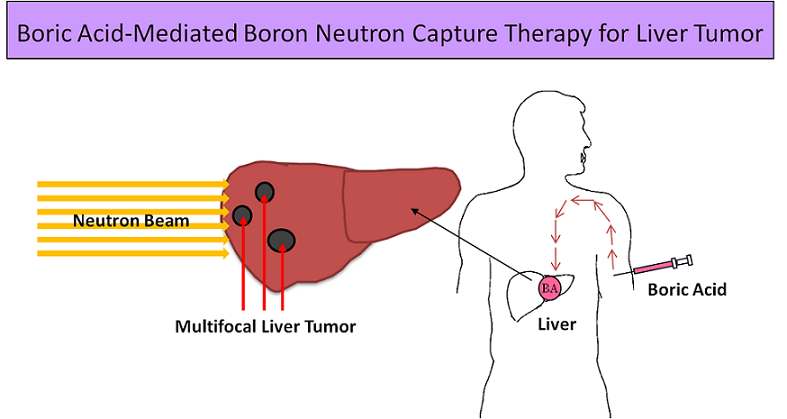
Mechanisms of Boron Neutron Capture Therapy
Boron neutron capture therapy (BNCT) is based on the nuclear reaction that occurs when boron-10 is irradiated with low-energy thermal neutrons to yield high linear energy transfer (LET) alpha particles and recoiling lithium-7 nuclei. Because the high LET particles have limited path lengths in tissue (5-9 μm), the destructive effect of these high-energy particles is limited to boron containing cells in BNCT. The high LET particles result in an increased biological effect compared with the same physical dose of low LET radiation (Barth 2005).
In theory, BNCT provides a way to selectively destroy tumor cells and spare normal cells. However, for BNCT to be successful, a sufficient amount of B-10 must be selectively delivered to the tumor (20 μg/g), and enough thermal neutrons must be absorbed by them to sustain a lethal boron neutron capture reaction. The challenge facing us is to develop boron drugs that can selectively target tumor cells, with little on normal cells and tissues adjacent to the tumor. Thus, boron concentrations sufficient to deliver therapeutic doses of radiation to the tumor with minimal normal tissue toxicity can be achieved. In the technology of BA-BNCT, BA highly targets to tumors and tumor vessels in liver, while normal tissues are spared. The killing of tumor cells and the disruption of tumor blood vessels may be responsible for the success of BA-BNCT for liver tumors (Yang 2015).
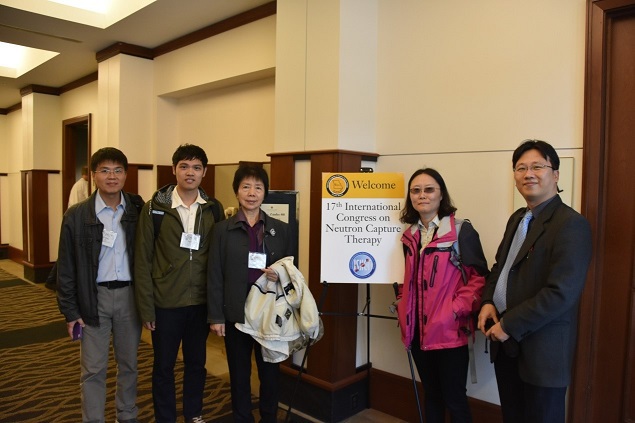
Prof. Chou, and the BNCT members took a photo at the 17th International Conference on Neutron Capture Therapy (at the University of Missouri, October 1, 2016)
visited: