
A Major Breakthrough in Battery Technology
At present, one of the greatest challenges in research related to consumer electronics is to develop batteries which are smaller and have a higher storage capacity. A research team led by Prof. Tuan Hsing-yu at the Department of Chemical Engineering, NTHU has recently developed a new battery material called "iodine-doped red phosphorus nanoparticles." In comparison to graphite—the electrode material currently used in lithium-ion batteries—this new material has a theoretical capacity seven times longer and a significantly extended lifespan, but at a cost only one-sixth that of graphite, making it a new milestone in battery research.
In addition to developing this new battery material, Prof. Tuan’s team has also used it to make the world's first usable battery with red phosphorus as the negative electrode. Their outstanding research results have recently been published in the prestigious journal Nano Letters, and have also been featured in Chemical & Engineering News, the most influential chemical engineering journal in the US.
Tuan said that at present lithium-ion batteries are widely used in consumer electronics, but their storage capacity can’t be further improved, due to the limitations of the graphite used to make their negative electrode. Some researchers have attempted to substitute phosphorus, the theoretical capacity of which is up to seven times that of graphite, but this proved impossible, since phosphorus is such a poor conductor of electricity. And even if it were possible to make it accept a charge, due to its rapid expansion, the phosphorus material would easily shatters after charging and discharging a few times. Attempts were also made to mix phosphorus and carbon, but it was found that diluted phosphorus has a much lower charging capacity.
Over the course of more than a year, the research team conducted tests on hundreds of different materials. Finally, using phosphorus triiodide as the raw material, they developed a method for synthesizing "iodine-doped red phosphorus nanoparticles," which can be synthesized in only five minutes at room temperature, has a conductivity 10 billion times greater than ordinary red phosphorus, and better yet, it doesn’t crack even after hundreds of charges and discharges.
Team member and first author of the article, Mr. Chang Wei-chong revealed that "reverse thinking" was their key to success. He said that in the past, researchers trying to synthesize nanophosphates mainly used high temperatures to release the precursor of phosphorus, but such high temperatures made it impossible for it to form into a nano-material. However, in one of his experiments Chang got surprising results when he used a precursor with a slightly lower boiling point: phosphorus triiodide. Afterwards, they redesigned their experimental system and succeeded in producing "iodine-doped red phosphorus nanoparticles," the first time a nano-material has ever been synthesized out of red phosphorus at room temperature.
Demonstrating this seemingly simple experiment, Mr. Chang added the black phosphorus iodide solution to the reduction solution containing a surfactant, and after some vigorous mixing, a bright orange-red material became visible: red phosphorus. When dried and turned into powder, red phosphorus can be used to manufacture electrodes for use in lithium-ion batteries. Inspired by his discovery, Chang has developed a special liking of orange-red color, and can often be seen in the laboratory wearing orange socks.
Team member Tseng Kuan-wei said that the experimental procedure was like looking for an optimal combination in the vast sea of chemical compounds, and that after hundreds of failures, finding the right combination was an experience that is hard to describe.
According to Tuan, since phosphorus is one of the most plentiful elements on the earth’s surface, it is cheap and easy to obtain, giving it great potential in the development of batteries that are smaller, lighter, and have a longer lifespan. Take, for example the latest Apple iPhone7, which has a graphite battery that weighs about 6 grams. A battery with the same capacity, but made with “iodine-doped red phosphorus nanoparticles” would weigh less than 1 gram.
Tuan’s research team has already applied for a multi-national patent for "iodine-doped red phosphorus nanoparticles." They are now planning to adapt the same material for use in sodium batteries, an application which would reduce the cost of a large-scale energy storage grids while increasing their capacity, thereby ushering in a new era of battery technology.
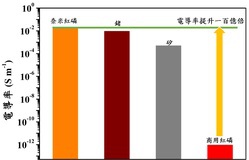
The conductivity of nanometer red phosphorous is higher than that of germanium and silicon, and over 100 times higher than that of commercial phosphorous.
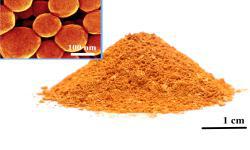
Powdered red phosphorous. Over the course of more than a year, after conducting tests on hundreds of different materials, using phosphorus triiodide as the raw material, Tuan’s research team developed a method for synthesizing "iodine-doped red phosphorus nanoparticles" in only five minutes at room temperature.
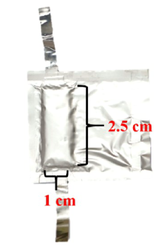
The softshell battery made by Tuan’s research team.
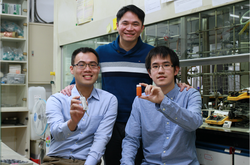
Professor Tuan with team members Chang Wei-chong and Tseng Kuan-wei.
visited: