
NTHU Researchers Discover Ancient Hoklo Dictionary
A team of researchers from NTHU’s Research Center for Humanities and Social Sciences, the Institute of Taiwanese History at Academia Sinica, and Spain’s University of Seville and Pompeu Fabra University in Barcelona have recently discovered a lexicon that provides important clues about the Hoklo language (or Holo, commonly known as Taiwanese) during the 17th century. Titled A Lexicon of the Changzhou Language (Spanish: Vocabulario de la Lengua Chio Chiu), the manuscript is about four hundred years old and consists of over 21,000 words and characters; its discovery is considered to have considerable value to the study of the pronunciation of Hoklo in both Manila and Northern Taiwan during the Ming dynasty.
Sponsored by the Chiang Ching-kuo Foundation for International Scholarly Exchange, over the past few years the research team has visited various archives in Spain, the Philippines and elsewhere looking for dictionaries and other ancient books relating to Hoklo. Thus the entire team was delighted by their discovery at the University of Santo Tomas in the Philippines of this lexicon which sheds considerable light on the Hoklo language as used by the overseas Hoklo community during the 17th century.
Team member Fabio Lee of NTHU’s Institute of History said that in 1571 the Spaniards began to import large amounts of silver from the Americas to the Philippines, leading tens of thousands of Hoklo people to emigrate to Manila. It was from these emigrants that the Spaniards learned about the geography and trade potential of Taiwan, and in 1597 they made the very first complete map of Hermosa (Taiwan), including the ports of Beigang, Jilong, and Danshui.
Eager to spread both Christianity and their trade network, the Spaniards enlisted Hoklo people living in Manila to help compile a number of books in and on the Hoklo language, the most significant achievement of which was the Changzhou Lexicon, in which Jilong and Danshui were described as the two areas occupied by the Spanish.
Lee also pointed out that these two entries indicate that the manuscript was produced during the Spanish occupation of northern Taiwan, which lasted from 1626 to 1642. Thus the Changzhou Lexicon predates the Kangxi Dictionary, begun in 1711, by nearly 100 years. It’s also the largest extent lexicon of Hoklo produced during the 16th and 17th centuries, and one-third of the entries include phonetic transcriptions indicating the pronunciation in both Hoklo and Mandarin.
Lee also said that the Changzhou Lexicon provides a wealth of useful information on the vocabulary used by Hoklo emigrants at the beginning of the 17th century, as well as various details relating to their geographical knowledge and daily life. For example, some of the expressions found in the Changzhou Lexicon are still in use in the Hoklo spoken in Taiwan, such as sey muy hong, literally “washing the lintel,” and figuratively “to restore one’s honor.”
Previously, the most important historical document on the Hoklo language was a grammar consisting of some 60 pages and explaining nearly 2,000 terms titled Arte de la Lengua Chio Chiu, which was discovered by the late Sinologist Piet van der Loon.
According to Lee, the discovery of the Changzhou Lexicon will provide a major boost to our understanding of the Hoklo diaspora, since it provides a wealth of information about their language and way of life, as well as how these have developed over the past four centuries.
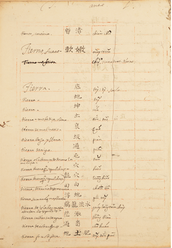
The page of the Changzhou Lexicon including the entries for Jilong and Danshui (fourth from the bottom).
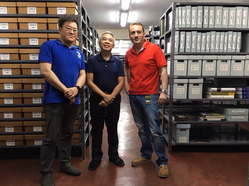
Fabio Lee of NTHU’s Institute of History; Regalado Trota Jose, archivist of the University of Santo Tomas; and José Luis Caño Ortigosa of the University of Seville (left to right).
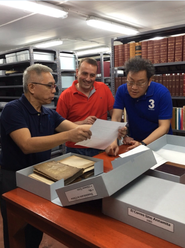
Members of the research team examining ancient manuscripts held in the archives of the University of Santo Tomas.
visited: