
Tsinghua Student Wins First Prize in the Entrepreneurship Day Competition
The sixth annual Tsinghua Entrepreneurship Day was held on May 31 with a total of 47 teams from across Taiwan participating. Li Wenbin, a doctoral student in the Department of Power Mechanical Engineering, won the first prize in the entrepreneurship category for his microfluidic wafer which provides rapid assessment of bacterial resistance. A team consisting of three freshmen from NTHU’s Department of Electrical Engineering won the first prize in the innovation category for their environmentally friendly food delivery platform.
This year’s competition was divided into two categories: innovation and entrepreneurship. Entrants in the former category only presented an innovative idea, while those in the latter category need to present a business model for manufacturing their product on an industrial scale. In this year's competition two subcategories were added to the entrepreneurship category: artificial intelligence (AI) and blockchain, the results of which were announced on June 1.
This year’s Entrepreneurship Day was organized by Prof. Kenneth Hsu. Hsu said that to succeed in business you have to be able to cater to industry trends, and this is why the AI subcategory was added to this year’s competition. He said that in recent years NTHU has been promoting interdisciplinary studies including expertise in the fields of AI and blockchain, both of which can be applied to such areas as media, medicine, and agriculture.
President Hocheng Hong pointed out that lots of students dream about starting a business without understanding the risks involved. Thus we initiated Entrepreneurship Day to encourage students to team up with like-minded classmates in coming up with innovative products and workable business plans. He also said that in recent years Tsinghua has been promoting interdisciplinary studies, dual expertise, and customized curriculum, all of which help to hone the skills needed to succeed as an entrepreneur.
Motivated by personal tragedy
Of the 11 teams competing in the entrepreneurship category, five made it to the finals, and the first prize went to Li Wenbin, a doctoral student in Department of Power Mechanical Engineering, for his entry “MedFluid.” Li’s father once came down with pneumonia and died due to resistance to the antibiotic treatment he received at the hospital. As a result, six years ago Li left his job at TSMC to pursue a doctoral degree at NTHU focusing on the problem of drug resistance.
Li has invented a microfluidic wafer that can detect 12 types of antibiotic resistances. A drop of the patient’s blood or saliva is dropped on the wafer, and within five hours it can be determined which antibiotics he is resistant to, as well as which combinations of antibiotics can effectively kill the bacteria. This helps the physician to prescribe the right medicine timely and save the patient's life.
After confirming that his invention was reliable, Li set about setting up a company for its commercial production with assistance from NTHU’s Creativity Garage and Innovation Incubation Center.
Saying goodbye to disposable tableware
Of the 11 teams competing in the innovation category, four received honorable mentions, and the first prize went to a team consisting of three freshmen from the Department of Electrical Engineering—Chen Weizhong, Ma Yuping and Cai Huiyun—for their environmentally friendly food delivery platform called the “Green Pepper Express.”
The Green Pepper Express is intended to solve a practical problem on university campuses. Lots of university students living on campus find it rather inconvenient to leave their dormitory to get a meal, and thus rely on local delivery services, which add a mere NT$5 for each order. Team captain Chen Weizhong said that the team's goal was to devise a delivery service which is both more convenient and less wasteful in terms of disposable materials. Next semester the team will begin working with a local delivery service by providing reusable tableware which can be cleaned and make ready for reuse.
Ma said that each member is planning to raise around NT$30,000 to get Green Pepper Express started, and that they have gained much benefit through their participation in the competition and their affiliation with the Innovation Incubation Center.
Using blockchains to detect fake news
Of the 11 teams competing in the blockchain subcategory, six made it to the finals. This was the first time a blockchain competition has been hosted by a university in Taiwan, and this segment of the competition was co-sponsored by blockchain pioneers Flowchain and EOS, both of which provided guidance and prizes. The first prize went to a team consisting of students from National Chengchi University, National Kaohsiung First University of Science and Technology, and National Taiwan University of Science and Technology for their entry “White Box,” which uses blockchains to identify fake news.
Team captain Qiu Chuijin, a junior of the Department of Statistics at National Chengchi University, said that their entry is an online news platform which identifies fake news by using big data, exciting legal codes and comparison with other news items. In order to encourage objective and fair news, readers can use tokens obtained on the platform to make evaluations which help the system to gradually improve its ability to distinguish between real news and fake ones.
Qiu said that his team members have great enthusiasm for blockchains and are planning to pursue it further after graduation. In addition to a cash prize, the winning team in the blockchain subcategory also received a prize in crypto currency from EOS and Flowchain.
Using AI as a fashion consultant
Of the 14 teams competing in the AI subcategory, five made it to the finals, one of which consisted of students from NTHU’s departments of Computer Science, Industrial Engineering and Engineering Management, Power Mechanical Engineering, and Economics for their entry “Beaut-AI-Ful,” a mobile application which applies AI to fashion styling.
Team member Jian Ruqian, said that their entry is designed for people who don’t want to waste time thinking about what to wear each day. After uploading photos of oneself and one’s wardrobe, all that’s required is to select one of the styles in the mobile app, and it will recommend what to wear. The app also keeps inventory of your wardrobe to refresh your memory when buying new clothes. She also said that they are planning to add a function for providing recommendations for the optimal sun protection factor (SPF) for sunscreen on a given day based on the current temperature, humidity, and UV index.
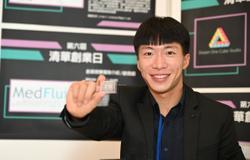
Li Wenbin, a Ph.D. student in the department of Power Mechanical Engineering, won the first prize in the entrepreneurship category for his microfluidic wafer which provides rapid assessment of bacterial resistance.
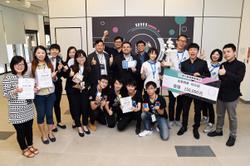
The five teams made it into the finals in the entrepreneurship category.
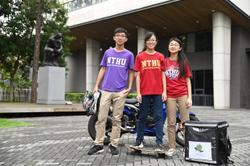
The Green Pepper Express team. From left to right: Chen Weizhong, Ma Yuping and Cai Huiyun.
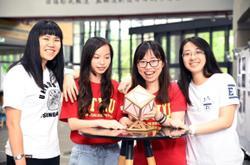
NTHU students with their entry “Embrave,” a nightlight with a built-in emergency messaging function.
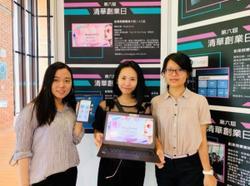
Amongst the finalists in the AI subcategory was an NTHU team which devised a mobile application called “Beaut-AI-Ful” which applies AI to fashion styling.
visited: