2020.07.16
Having established a strong reputation in international competitions over the past few years, on July 16 the student club NTHU Racing announced the completion of its third generation electric racecar, which can accelerate from 0 to 100 kilometers per hour in a mere 2.7 seconds. This is the first four-wheel-drive racecar built by students in Taiwan. This year's international competition was cancelled due to the covid-19 pandemic, and the team is now preparing for next year's event.
Dropping gasoline in favor of electric
Mainly composed of students at the Department of Power Mechanical Engineering, NTHU Racing also has members from the departments of Physics, Economics, and Chemistry, and the club has been competing in the Formula SAE competition held in Japan since 2015. Their first two entries ran on gasoline, but in 2018 they switched to the electric-powered division, and came in fourth place; last year their second-generation electric racecar came in second place, and now their sights are firmly set on winning first place in the electric division.
Team captain Chen Zijing said that NTHU Racing spent about one year designing and building it’s third-generation electric racecar, during which time they redesigned the batteries, chassis, aerodynamics, and brakes. By switching to a high-density ternary lithium battery, which reduced the weight of the battery box from 75 kg to 55 kg, and by adding a third shock absorber, they have come up with a racecar which is lightweight, fast, stable, and highly maneuverable.
Made in Taiwan
Another feature of this third-generation electric racecar is that it was completely made in Taiwan, including the high-performance motor sponsored by ADATA Technology, unlike its predecessors, which used some imported parts.
Chen said that it’s difficult to compete with Europe and the United States in the production of a gasoline engine, since they’ve been at it for so long, but when it comes to electric motors, Taiwan is already a frontrunner in cutting edge technology, adding that he’s heard that the Student Formula competitions in Europe are planning to drop the gasoline engine division from this year’s events, indicating that electric motors are the trend of the future.
In their first three years competing in the gasoline-engine division of Student Formula Japan, NTHU Racing’s highest ranking was 21st. However, in 2018 they entered the electric division for the first time and came in fourth place, providing a major boost in morale. Another source of confidence was the fact that lots of the Japanese teams had received technical guidance from large car manufacturers, resulting in designs differing only in various details; by contrast, NTHU Racing basically built its entry from scratch, using a process of trial and error which, when based on a solid foundation, leaves relatively more room for making major improvements.
Future challenges
Dubbed “TH05,” the team’s recently completed electric racecar is on par with Tesla’s electric sports car, which can accelerate from 0 to 100 kilometers per hour in 2.6 seconds.
Not content with speed alone, NTHU Racing is now planning to develop an unmanned vehicle, a project which is being led by team member Hsieh Shenghan, a master's student of the Department of Power Mechanical Engineering. Nicknamed “Mr. Magic,” Hsieh played a leading role in the development of TH05’s electrical system.
Developing the electrical system
Something of an eccentric genius in the eyes of his younger classmates, Hsieh began his undergraduate studies in the Department of Physics, during which time he took lots of electives in other departments in accordance with his interests, but never completed a number of required courses, as a result he never graduated. Nonetheless, his grades were so good that he still managed to gain special admission to the Department of Power Mechanical Engineering’s M.A. program. Hsieh joined NTHU Racing in his sophomore year, and has been an active member ever since.
Hsieh has played the leading role in developing the electric racecar’s battery system and motor drive; whenever he gets stuck, he quickly finds a solution, and never misses an opportunity to learn something new.
As Hsieh sees it, relying on a manufacturer for the core technology of an electric vehicle speeds up initial progress, but leaves little room for further development, so overall it’s better to take a DIY approach and start from scratch. The same goes for developing an unmanned vehicle, which Hsieh is confident the team will be able to pull off.
A multi-talented team
At its inception, NTHU Racing had only about a dozen members, but membership has gradually increased, and now stands at 50. Located behind Engineering Building I, the team’s workshop is often bustling with activity late at night.
The team’s driver is Chiu Chingyu. He is 173 cm tall and has to keep his weight within 52 kg, since even a single extra kilogram would affect the racecar’s performance.
Team Captain Chen said that the team is very grateful for the school’s support, and for all the expert guidance provided by team mentor Professor Lin Chao-an, who knows how to give students a lot of freedom and space, but is always ready to lend a hand when necessary, especially when it comes to fundraising.
|
Specifications for NTHU Racing’s TH05
|
|
Drive type
|
four-wheel drive
|
|
Speed: 0–100 km/h
|
2.7 seconds
|
|
Horsepower
|
160 hp
|
|
Torque
|
160 kg-m
|
|
Voltage
|
430 v
|
|
Battery capacity
|
7.26 kWh
|
|
Reduction ratio
|
11.01
|
|
Weight
|
303 kg
|
|
Maximum torque
|
352 N-m per wheel
|
|
Wheelbase
|
1560 mm
|
|
Axle track
|
front wheel: 1270 mm
|
|
rear wheel: 1220 mm
|
|
Suspension
|
front: double A-arms with anti-tilt bar
|
|
rear: double A arms
|
|
Tire size
|
205/470 R13
|
|
Brake type
|
four-wheel disc brake
|
|
Disk size (diameter)
|
front: 220 mm
rear: 200 mm
|
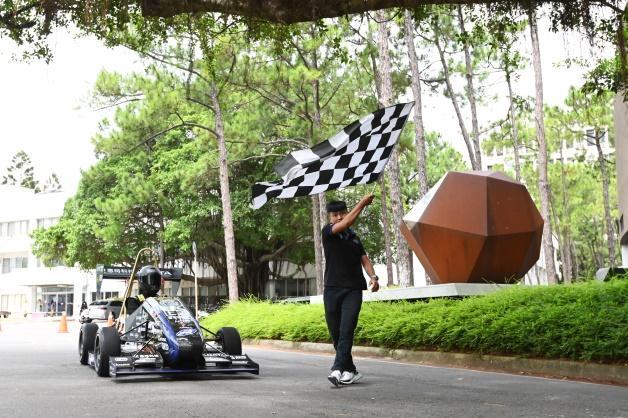
Taking a test drive on campus.
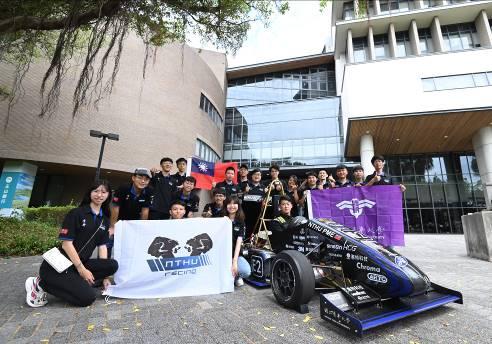
At its inception, NTHU Racing had only about a dozen members, but membership has gradually increased, and now stands at 50.
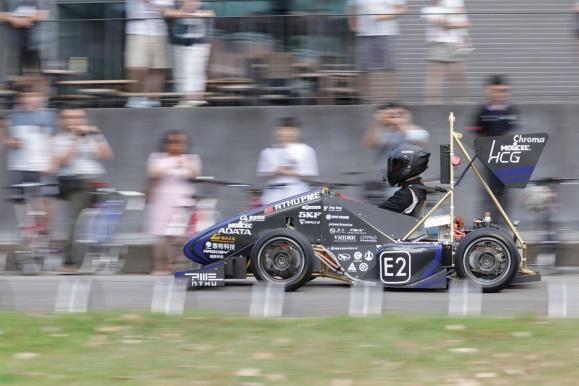
Taking a test drive on campus.
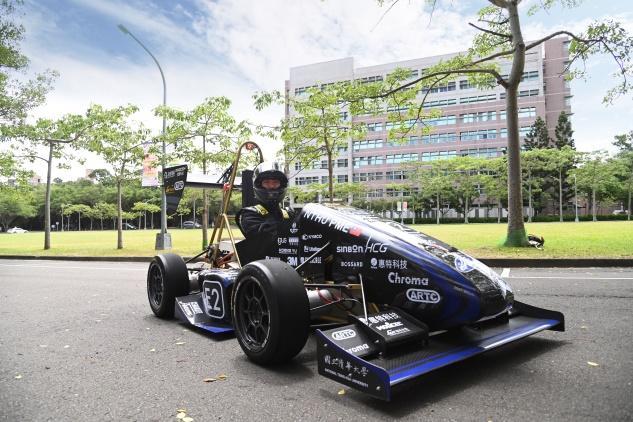
NTHU Racing's TH05 is the first four-wheel-drive racecar built by students in Taiwan..
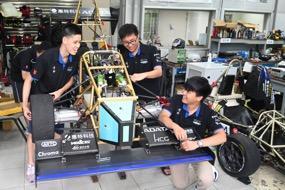
NTHU Racing team members (left to right): Chiu Chingyu, Hsieh Shenghan, and Chen Zijing (captain).
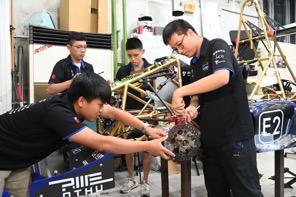
NTHU Racing assembling their electric racecar.

The team's driver is Chiu Chingyu.
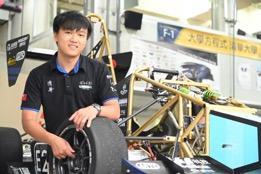
Team captain Chen Zijing developed the racecar's battery system.
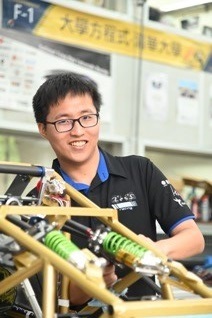
Team member Hsieh Shenghan developed the racecar's electrical system.
