2021.04.29
On April 29 NTHU awarded an honorary doctorate in economics to Perng Fai-nan(彭淮南), the former governor of the Central Bank, in recognition of his outstanding contributions to Taiwan’s economy. At the award ceremony Perng said that he is doubly pleased to receive this honor, due to NTHU’s world-class reputation, and since Hsinchu is his hometown.
Perng said that the main force that has driven him forward over the years has been his strong sense of mission and the encouragement he has received from the people of Taiwan. He said that he began working at the Central Bank in 1971 and retired 2018, and recalled the impression his strong sense of mission had on his colleagues. He was especially keen on writing analysis reports, which in the days before computers was very time consuming; thus he often worked late into the night.
“Having a sense of mission has always spurred me to get to the root of the matter,” explained Perng, adding “Although I’m now retired, I still follow economic issues very closely, and present my views to government policy makers. My lifelong aspiration is to benefit the people.”
Noting that during his tenure as governor of the Central Bank there were three changes in ruling party, four different presidents, and 15 different premiers, Perng said, “fortunately, thanks to the trust of the Legislative Yuan and other senior officials, the Central Bank has been able to maintain a high degree of independence within the government structure.”
During Perng’s nearly 44 years at the Central Bank he had many opportunities to change jobs, but chose to stay put. Including his earlier positions at the Bank of Taiwan, the Central Trust of China, and China Trust, he has worked in the banking industry for over 51 years, about which he said, “My first job was as a banker, and the last job was also as a banker. This is something I take pride in.”
The limited impact of interest rates on the housing market
In his acceptance speech, Perng took the opportunity to explain the relationship between interest rates and housing prices. He emphasized that for monetary policy to be effective, it must be properly coordinated with fiscal policy. In 2009 the government drastically lowered the bequest tax rate, which, coupled with declining returns on foreign investment due to the global financial crisis, led a large number of Taiwanese to repatriate their overseas funds for purchasing local real estate. In order to maintain financial stability, in October 2009 the Central Bank launched a moral persuasion campaign calling for voluntary restraint, began conducting special financial inspections, and began urging financial institutions to strengthen their controls against real estate credit risks. Furthermore, beginning in June 2010 the Central Bank successively imposed restrictions on mortgages for a second home in specific areas, a maximum amount for home loans throughout Taiwan, and a maximum loan-to-value ratio for the purchase of land. These targeted preventative measures were applauded by the international credit rating company Moody’s.
But why did the Central Bank adopt this targeted approach for dealing with skyrocketing housing prices, rather than simply raising interest rates? Perng explained that it’s a matter of prescribing the right medicine. The real estate market is only one part of the overall economy, but raising interest rates would have had an impact across the board, resulting in some unwanted side effects. Moreover, only 26 percent of homes in Taiwan are purchased with a mortgage, so the impact of interest rates on the housing market is limited.
Citing the views of the International Monetary Fund (IMF), Perng pointed out that raising interest rates is not a good way to deal with rising housing prices. Providing a recent example, he said that the Swedish Riksbank raised interest rates in July 2010 in order to curb rising housing prices; however, this led to increased deflationary pressure, and in December 2011 the Riksbank made a U-turn and began lowering interest rates, which actually dropped to zero in October 2014. He also noted that research conducted by the IMF found that low interest rates don’t necessarily cause housing prices to rise. Citing two examples, he pointed out that between 2002 and 2006, interest rates in the UK and Australia were higher than those in the US, but their housing prices rose more than in the US. During the same period, Japan maintained low interest rates, but its housing prices decreased.
The upshot, emphasized Perng, is that the real interest rate in Taiwan has not been excessively low in recent years. In fact, for most of the period beginning in 2009, the real interest rate in Taiwan was higher than that of most other industrialized nations. Furthermore, research by Nomura Securities of Japan found that Taiwan’s interest rates are not excessively low. Perng was also a major proponent of increasing the capital gains tax on short-term real estate sales; once it was implemented, speculators withdrew, the transaction volume significantly dropped, and the housing market cooled down.
The second honorary doctorate in economics from NTHU
Perng is the 39th person to receive an honorary doctorate from NTHU since 1996, and the second to receive such an honor in economics; the first honorary doctorate in economics was awarded to Yu Kuo-hwa, who had also served as the governor of the Central Bank.
Perng was jointly nominated for the honorary doctorate by the College of Technology Management (CTM) and the NTHU Taipei School of Economics and Political Science (TSE). The recommendation was read by TSE dean Huang Chao-hsi, who praised Perng for his outstanding leadership during his 20 years as governor of the Central Bank.
CTM dean Lin Che-chun(林哲群) said that Perng was the governor of the Central Bank for two decades, during which time he successfully led Taiwan through the global financial crisis and the European debt crisis, and helped to keep the inflation rate below two percent. He also noted that Perng received the A rating from the magazine Global FinanceGlobal Finance 14 times, setting a record.
Paying respect at the Dr. Mei Memorial Garden
After the ceremony, Perng paid a visit to the Mei Garden to pay his respects at the mausoleum of Mei Yi-chi, who reestablished NTHU in Taiwan and served as its first president. When Mei died in 1962, his remains were brought from Taipei back to NTHU for interment, and Perng, then a student at the Hsinchu Commercial and Vocational High School, was amongst the mourners lining the road leading to Mei’s final resting place. He said that now that he is an official member of the Tsinghua community, he ought to personally pay his respects to its founder.
All of the members of the honorary doctorate committee were in full agreement as to Perng’s outstanding qualities, including his conscientious attitude, humble demeanor, and low-key manner. Perng personally wrote his 22-page acceptance speech, revised and proofread it multiple times, and even added diagrams and notes, further attesting to his impeccable diligence in carrying out every task, down to the last detail.
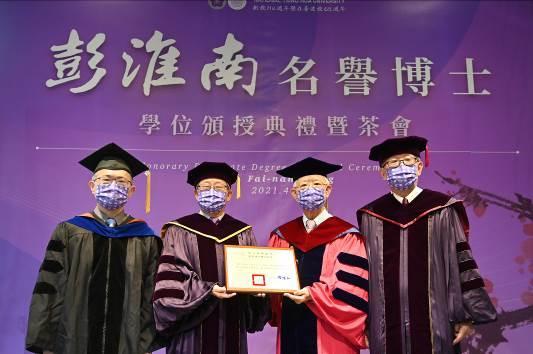
At the conferral ceremony (left to right): CTM dean Lin Che-chun(林哲群), NTHU president Hocheng Hong, former Central Bank governor Perng Fai-nan(彭淮南), and TSE dean Huang Chao-his(黃朝熙).
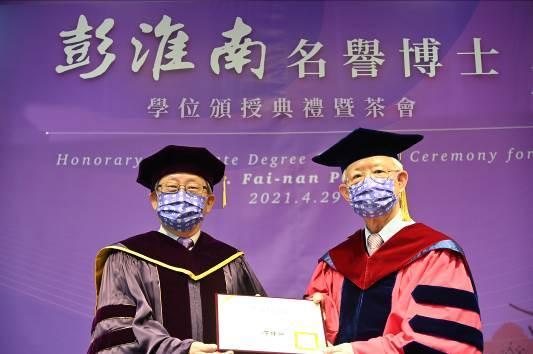
President Hocheng Hong (left) presenting an honorary doctorate in economics to former Central Bank governor Perng Fai-nan.
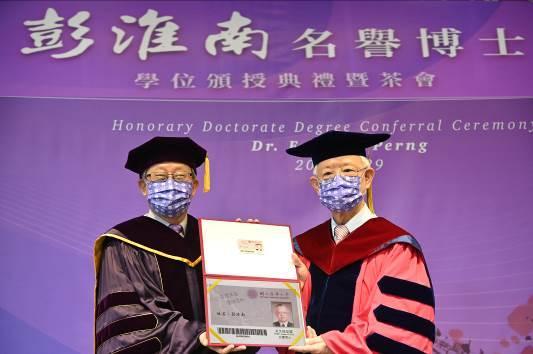
NTHU president Hocheng Hong (left) presenting former Central Bank governor Perng Fai-nan with his lifetime alumni card.
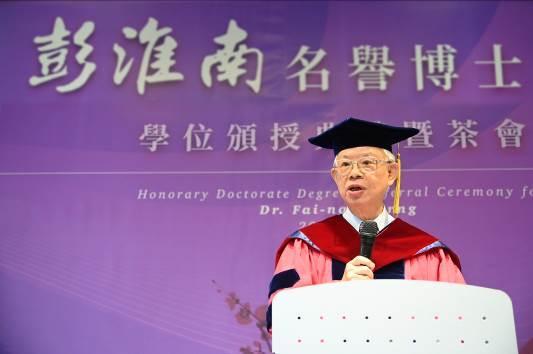
During his acceptance speech Perng said that the main force that has driven him forward over the years has been his strong sense of mission and the encouragement he has received from the people of Taiwan.
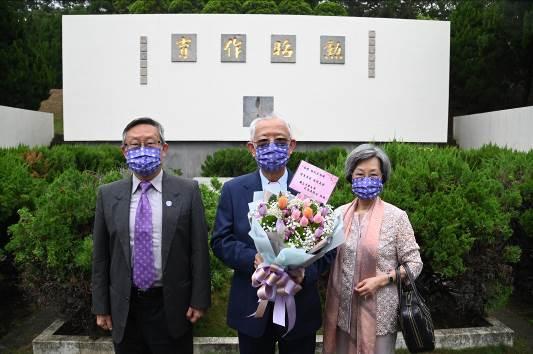
After the ceremony, Perng paid a visit to the Dr. Mei Memorial Garden to pay his respects at the mausoleum of Mei Yi-chi. Hocheng (left) with Mr. and Mrs. Perng.
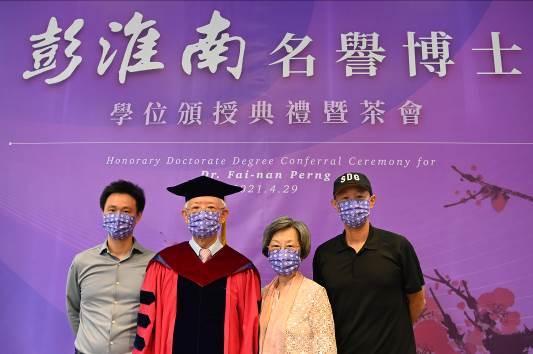
Joining Perng were his wife and two sons.
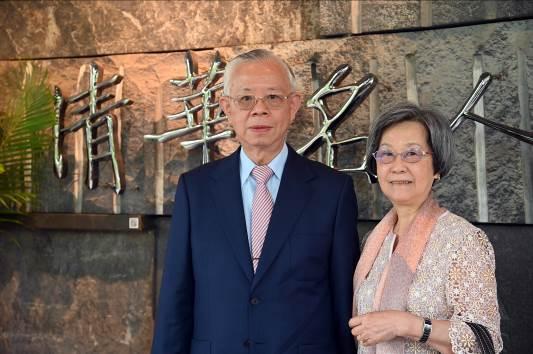
Mr. and Mrs. Perng at the conferral ceremony.
