
NTHU Identifies a Quantum Critical Point in High-Temperature Cuprate Superconductors, Shedding Light on a 40-Year-Old Mystery
2026.10.06
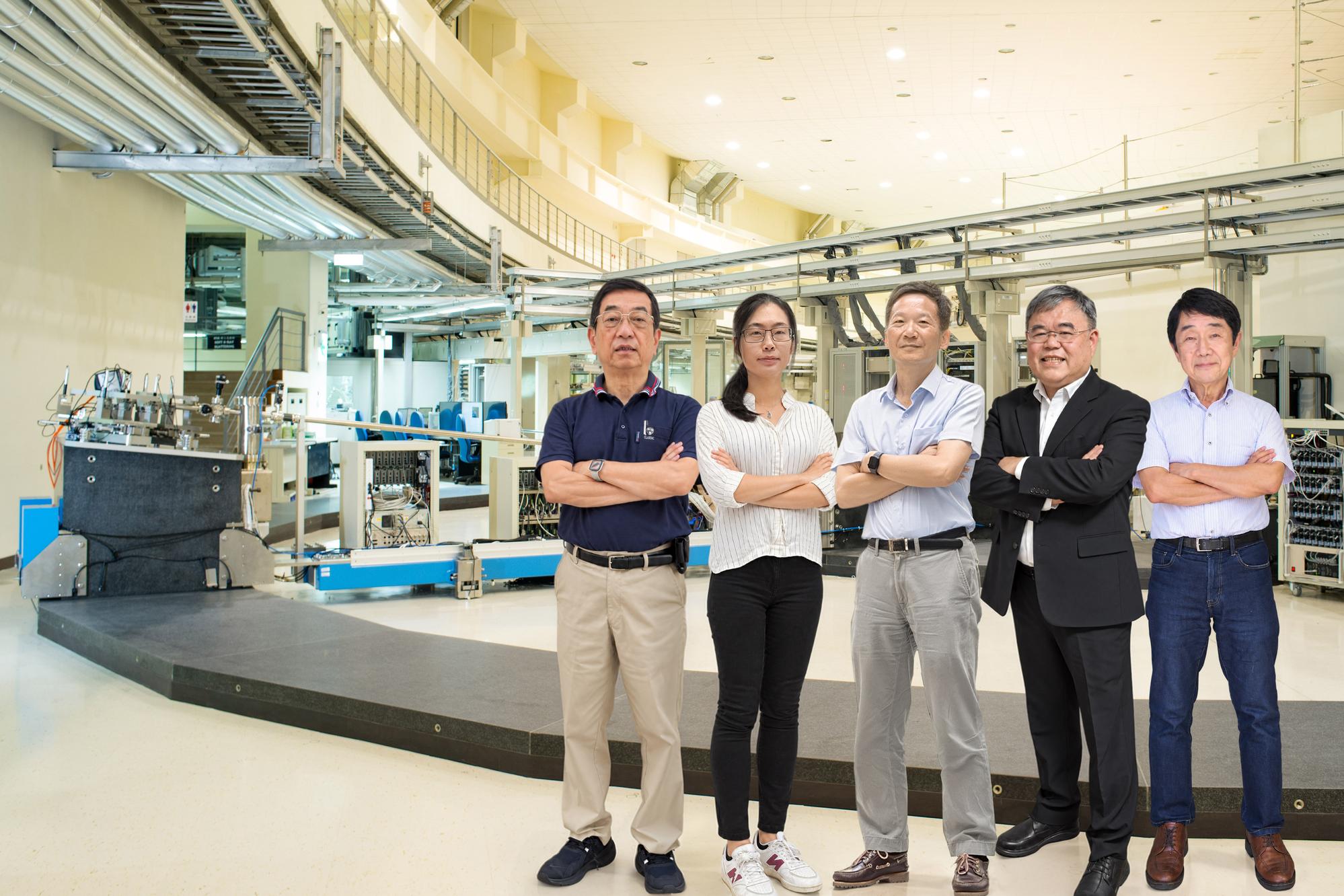
Chung-Yu Mou (center), Dean of the College of Science at National Tsing Hua University (NTHU), and an international research team have confirmed the existence of a quantum critical point in high-temperature cuprate superconductors.
Nearly 40 years after the discovery of cuprate high-temperature superconductors, the key mechanism behind their superconductivity at relatively high temperatures remains one of the most important unsolved problems in physics. An international research team including Chung-Yu Mou, Dean of the College of Science at National Tsing Hua University (NTHU) in Taiwan, has provided the first definitive evidence of a quantum critical point (QCP) in the complicated phase diagram of high-temperature cuprate superconductors—a point long obscured by the superconducting state. The team also clarified how the material's quantum states change on either side of this critical point.
Dean Mou said these findings offer a clearer picture of the complicated phase diagram of high-temperature superconductors and provide an important benchmark for testing theoretical models. The results have been published in the prestigious international journal Nature Communications.
Dean Mou further explained that superconductivity is a quantum phenomenon in which a material exhibits distinctive properties upon entering the superconducting state, including zero electrical resistance and the expulsion of magnetic fields. High-temperature superconductivity does not refer to the scale of temperatures in everyday terms, but rather to materials that become superconducting at higher temperatures than conventional superconductors.
One of the major challenges in understanding the mechanism behind the high-temperature superconductivity in cuprates is that cuprates exhibit multiple competing and intertwined orders as temperature and electron doping levels change. These include superconductivity and charge density waves. Scientists map these states in what is known as a phase diagram. Dean Mou said that the diagram resembles a map of the different states for cuprate superconductors, with the newly identified quantum critical point representing a landmark that had long been hidden beneath the superconducting state.
Dean Mou further pointed out: “A quantum critical point is the boundary point at which the material makes the transition from one quantum state to another as conditions such as doping or pressure changes at zero temperature.” Scientists have long suspected that a quantum critical point exists in the phase diagram of high-temperature cuprate superconductors. However, because the suspected point lies beneath the “superconducting dome,” the material enters the superconducting state before clear signatures of quantum criticality can emerge. This makes it difficult to measure the relevant signals, resulting in the absence of conclusive evidence confirming its existence.
To locate this hidden critical point, the research team used high-resolution resonant inelastic X-ray scattering (RIXS) at the Taiwan Photon Source operated by the National Synchrotron Radiation Research Center. The team investigated lanthanum strontium copper oxide (LSCO), a high-temperature cuprate superconductor, and tracked changes in charge density wave (CDW).
Dean Mou added that charge density waves can be understood as an uneven distribution of electric charge, which present a spatial periodic fluctuation that alternates between higher and lower charge density.
The team found that experimental data collected at different temperatures and doping levels, while seemingly distinct, actually followed the same underlying quantum critical law. This phenomenon, known as quantum critical scaling, is a key signature of materials approaching a quantum critical point and provided the crucial evidence confirming its existence.
The analysis further revealed that on one side of the quantum critical point, charge density waves, superconductivity and another type of electronic pairing state known as a pair density wave, coexist and intertwine. Beyond the critical point, the material makes the transition to a plain superconducting state. Dean Mou said that this discovery further serves to mark out distinct "topographies" on either side of the quantum critical point, clarifying their distinct “landscapes.” Future theories aiming at explaining high-temperature superconductivity in cuprates will need to account for the key features observed in these experiments.
Dean Mou specifically noted that this research was carried out through the collaborative efforts of an international team. Di-Jing Huang, Distinguished Research Fellow at the National Synchrotron Radiation Research Center (NSRRC) and adjunct professor at the physics department of NTHU, coordinated the research and data analysis; Hsiao-Yu Huang, Assistant Research Fellow at NSRRC, performed the experiment and data acquisition; Dean Mou was responsible for the theoretical analysis, and for developing the model and the analytical method used to identify the quantum critical point; Atsushi Fujimori, Honorary Chair Professor in the Department of Physics at NTHU, was responsible for the acquisition of the samples needed for the experiments, and Academician Ting-Kuo Lee participated in research discussions and contributed important ideas for analyzing the data.
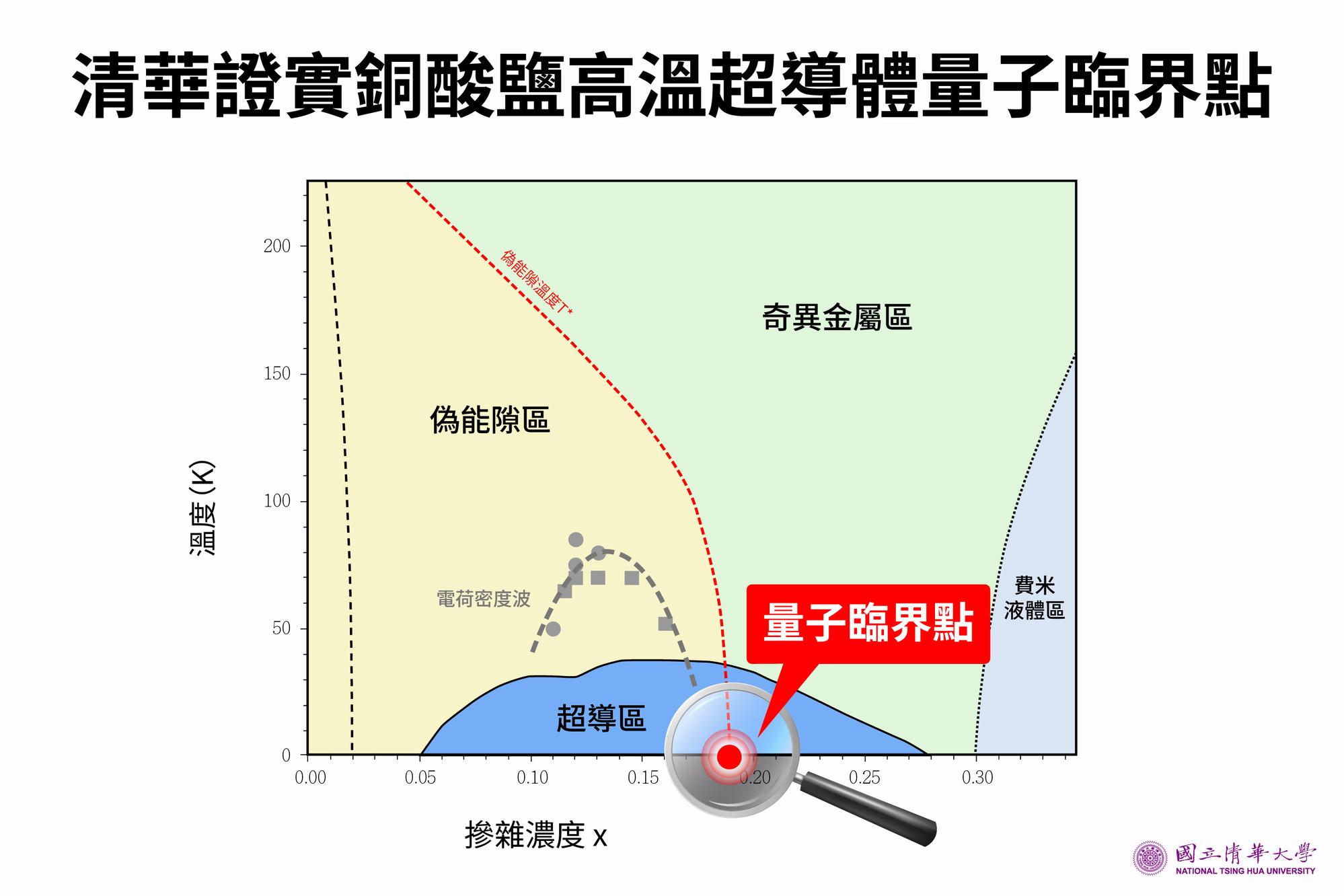
NTHU Confirms Quantum Critical Point in High-Temperature Cuprate Superconductors
NTHU researchers have provided the first definitive evidence that a quantum critical point (QCP), long obscured by the superconducting state, does indeed exist.
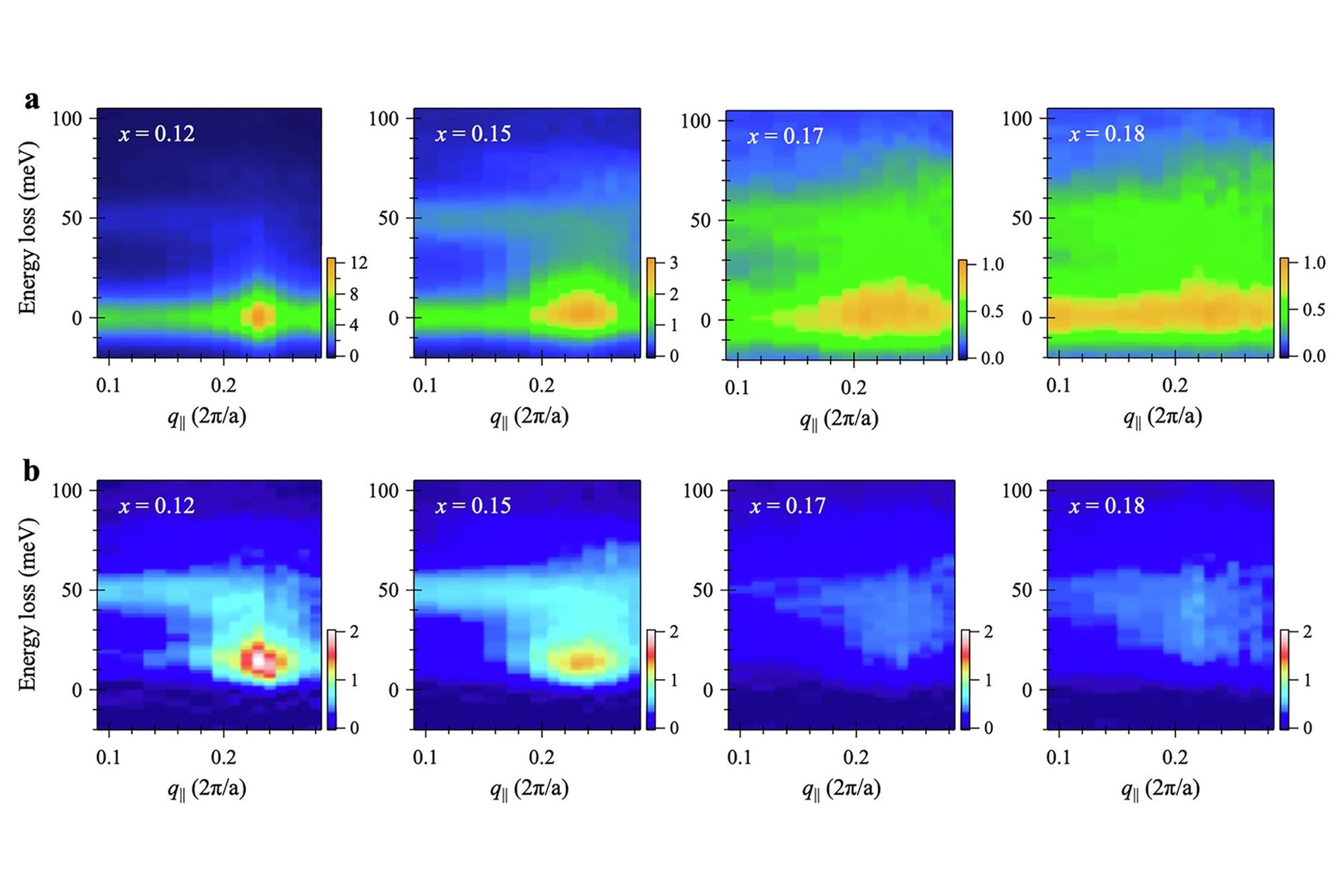
Using X-rays from the Taiwan Photon Source, the NTHU team observed charge density wave in lanthanum strontium copper oxide (LSCO), providing evidence for the existence of the quantum critical point.
visited: