
Bigshot : Professor Po Wen Chiu's Research on the Growth Mechanisms of Graphene Published in Nature Communications
Prof. Po Wen Chiu of the Department of Electrical Engineering and Institute of Electronic Engineering leads a research team investigating double-layer graphene. Using a scanning transmission electron microscope, they have become the first researchers to observe the process by which carbon atoms form into graphene. Their report on this innovative breakthrough has been published in the June issue of the prestigious British journal Nature Communications (DOI: 10.1038/ncomms5055).
Prof. Chiu often points out that the discovery of graphene led to many advances in the field of nanoscience. Firstly, it enabled researchers to use the single-atom thickness of graphene to verify the peculiar zero-mass fermions exhibited by low-energy electrons. Also, graphene is an excellent conductor of electricity and heat, making it highly suitable for high-speed electrical components, touch panels, and transparent conductive film.
As for practical applications, large-area graphene films need to be prepared through a process of chemical vapor deposition. The key factors in determining the quality of the graphene film are the grain boundaries and derivatives. Chiu says that understanding the growth mechanism of graphene and how to control its growth characteristics is the focus of his research. However, the graphene structure grows relatively quickly (at a rate of about 100–200 atoms per second), and is therefore difficult to observe.
In cooperation with Japan's AIST, Prof. Chiu used bilayer graphene in a single-crystal, small-layer border to form an epipole. When the temperature dropped from 1050° C to 500° C, with the remaining ultra-low hydrocarbon gases as a carbon source, it was possible to control the growth rate of the graphene. Then they used adsorption of single silicon atoms to catalyze the side-edge growth of the graphene. At the same time, they used a scanning transmission electron microscope to simultaneously observe the carbon atoms slowly crystallize one by one, in the process discovering how to use five-ring and seven-ring deficiencies to rotate the direction of the crystalline structure.
As Prof. Chiu puts it, "Inventiveness and persistence are the keys to breakthroughs in science and technology!" The keys to success are teamwork and a detailed division of labor, so that every member of the team works in a highly efficient manner. Recalling the process of the experiment, he says that each member of his team is a highly talented, has a high degree of enthusiasm for science, and is willing to spend lots of time and effort to develop new technology.
Team members Chun-Chieh Lu and Chao-Hui Yeh, widely acknowledged for their skill in growing graphene, were able to use the chemical vapor deposition method to achieve perfect crystal stacking. Yung-Chang Lin, whose graphene transfer technique is unsurpassed, has become a celebrity, and his contribution has been a key factor in the team's success. Finally, Zheng Liu's superb skill in the use of the electron microscope has been honed over a long period of time. In fact, the contributions of each and every member of the team were indispensable, and the entire team is very pleased to see their efforts recognized.
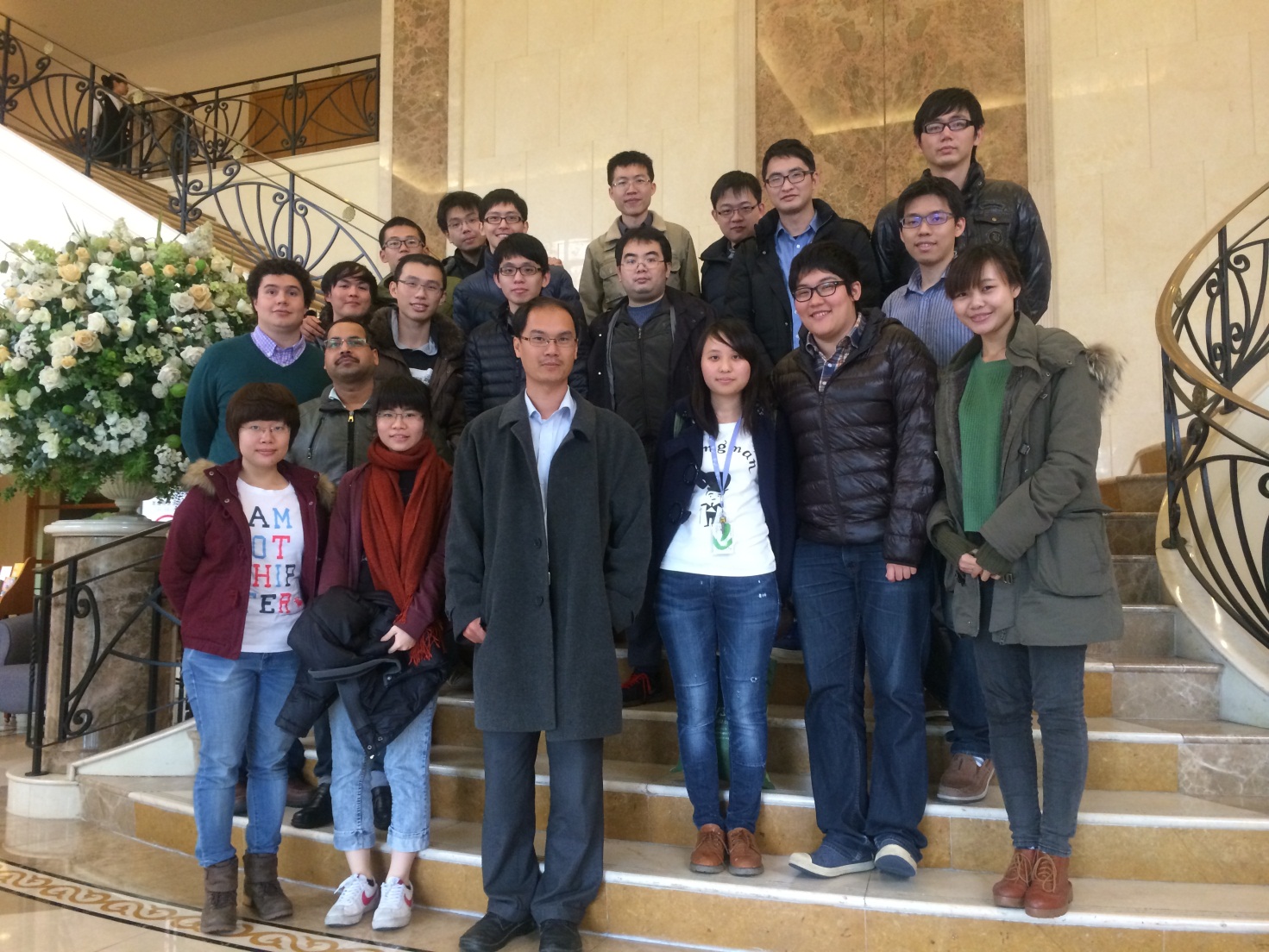
Professor Po Wen Chiu's team members
visited: